

India’s rising steel capacities
Demand-supply balance and the competitive position of South India’s mills.

After successful editions in Chandigarh (North) and Chennai (South), BigMint brings the 3rd edition of Future.Steel to Hyderabad — one of South India’s fastest-growing industrial and infrastructure hubs. Telangana’s expanding manufacturing corridor, rising infrastructure investment, and its position at the heart of South India’s steel demand story make Hyderabad the natural home for this edition.
Future.Steel Hyderabad 2026 unites key stakeholders across the steel value chain to explore actionable insights under five critical pillars: Pricing, Policy, Trends, Technology, and Sustainability — with a sharp focus on the opportunities and challenges defining South India’s steel future.
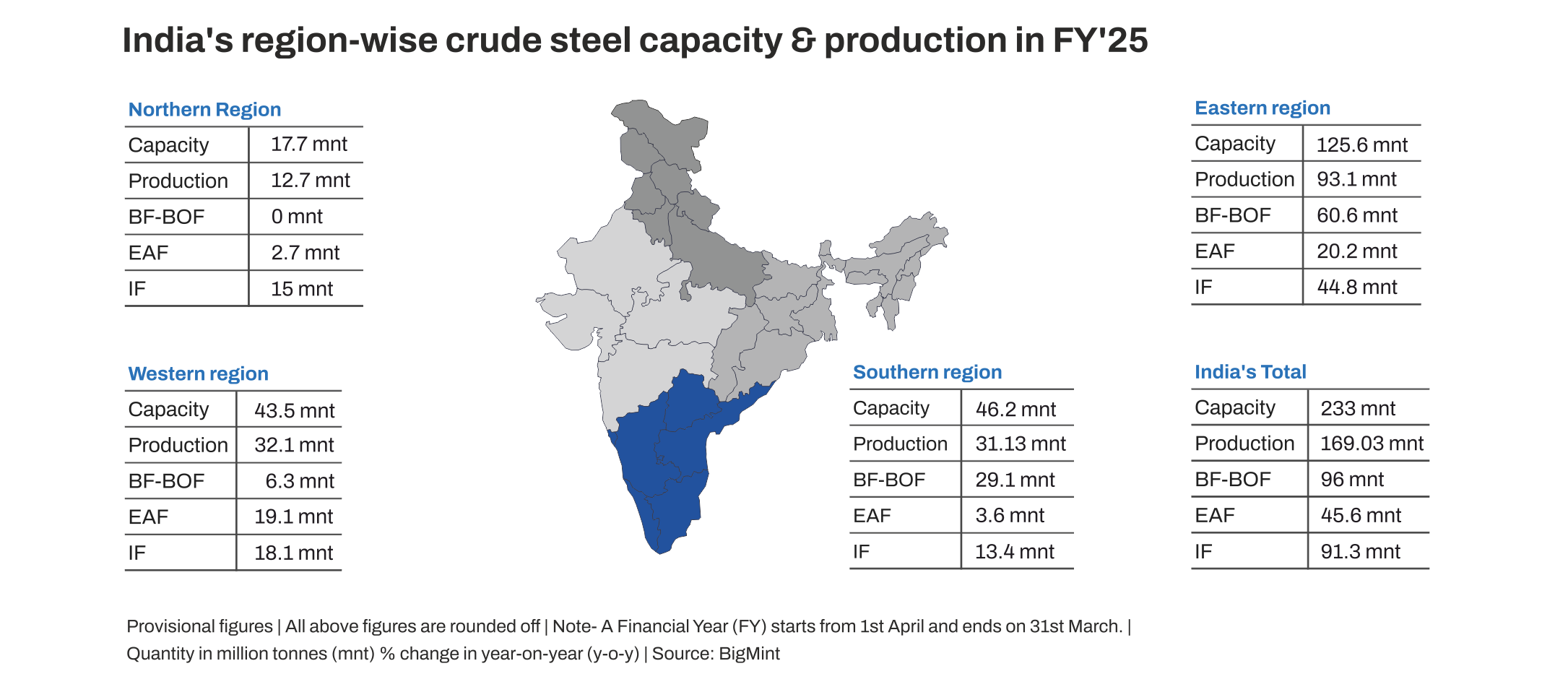
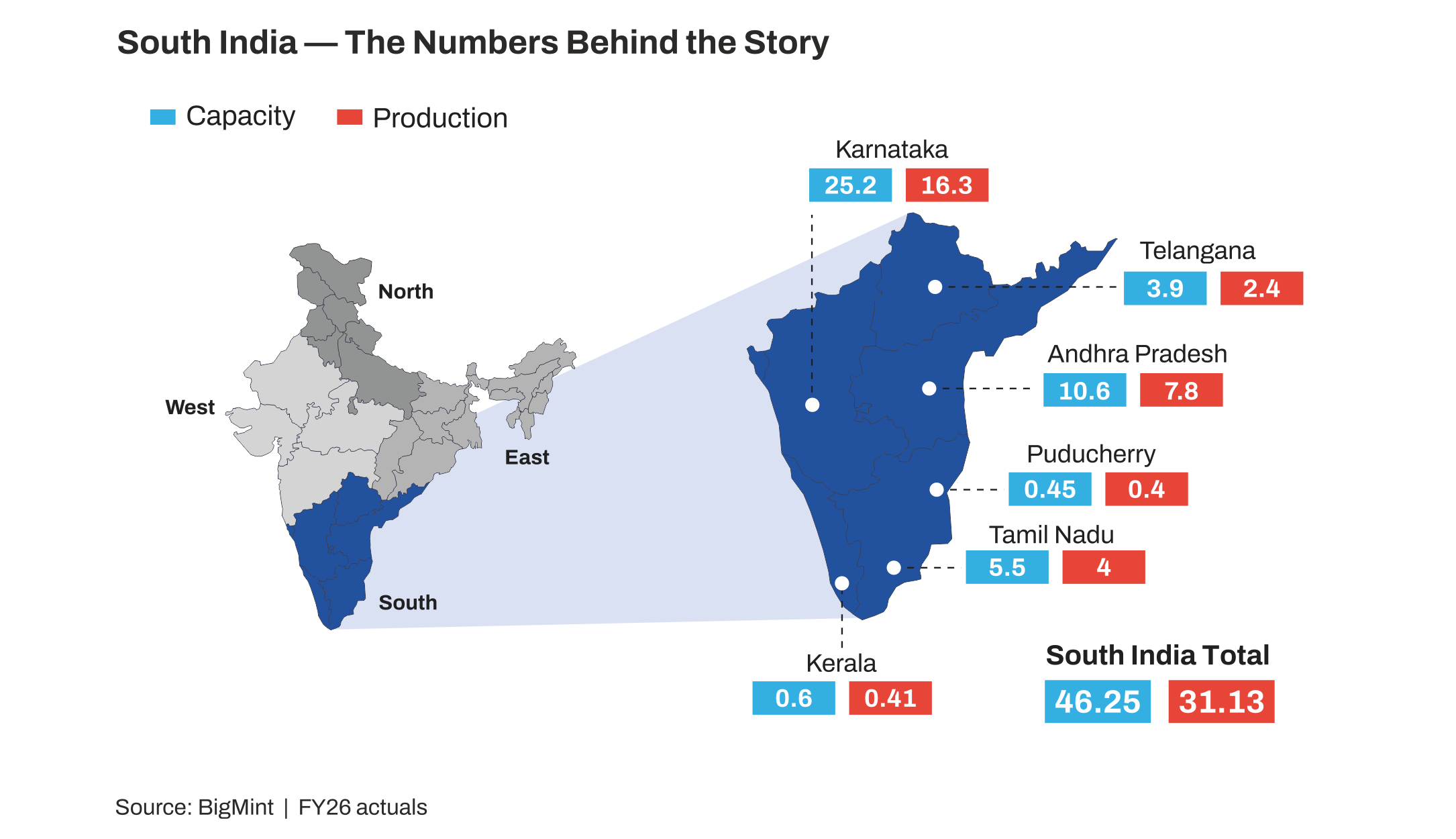
Hyderabad is where South India’s industrial ambition is most visible. The Regional Ring Road, metro expansion, defence manufacturing, pharma infrastructure, and IT campuses are generating steel demand at a pace few cities in India can match. And with Karnataka, Andhra Pradesh, and Telangana together forming the backbone of the South’s 46.2 MnT steel capacity, Hyderabad sits at the strategic centre of where that steel actually goes.
India’s crude steel capacity hit 233 MnT in FY26, with production at 169 MnT. South India holds 46.2 MnT of that capacity and produces 31.1 MnT — 67% utilisation, with real headroom and real constraints. The region’s scrap-heavy production mix (63% BOF, 29% IF, 8% EAF) gives it a structural emissions advantage that is currently going unmonetised. That changes when India’s green steel taxonomy takes effect.
Demand-supply balance and the competitive position of South India’s mills.
Tightening supply, export restrictions and implications for India’s secondary sector.
Scrap-based vs sponge-based — what the data shows on product quality and emissions.
South India’s structural advantage, MoS taxonomy, green premiums — who captures value and how.
The case for price indexing in volatile input markets.
Corrosion-resistant, seismic-grade and high-ductility long products.
BIS standards, scrap recycling, RCM in GST, EOL vehicle scrappage, state investment schemes.
Reshaping South India’s steel plants — from high-speed rolling to AI-driven process control.